Keeping Your Garden Cool In A Heatwave
With high temperatures still in the weather forecast, we’re looking at ideas for keeping your garden cool in a heatwave.
If climate change scientists are correct, we are likely to be treated to scorching hot summers on a regular basis. In some ways, that’s nice, it’ll be like an exotic holiday without the hassle of flying anywhere. But honestly, sometimes too much heat is just, well, too much. So how can we manage our immediate environment, ie our gardens, to make them feel cooler and more comfortable in a heatwave? Here are my suggestions.
- Plant trees and hedges to provide shade
- Install a pergola or some other structure to create a cool spot
- Make sure that your garden includes as many plants as possible
- Opt for natural lawns rather than artificial turf
- Keep adding organic matter to the soil – it will cope with heat and drought much better
- Choose colour schemes wisely – some colours are better at fooling your brain into feeling cooler
- Create sheltered spots with plenty of shade
- Position garden features carefully – you may want more than one seating area so that you can move in or out of the sun
- Consider installing a water feature – the sound (and feel) of running water helps cool you down

A pergola with a louvred roof allows you to control the amount of shade/shelter it offers
Pergolas and Summerhouses for Shade
Pergolas, summerhouses and outdoor rooms are becoming more and more popular in modern gardens. Their primary function may be to provide shade, but actually they do much more than that. Extra living room, an ‘escape zone’ for frazzled parents, play houses for the youngsters, entertaining space, outdoor cinema, al-fresco cooking and eating – the list goes on.
A few design tips for outdoor rooms…..
- Louvred roofs give you the option of full or part shade and can also be closed against the elements on rainy days.
- Installing lighting comes at a relatively low cost compared to the extra value it adds to your pergola
- Detatchable sides give you even more flexibility
- Beautiful planting around your pergola (or even over it!) will help make it feel more luxurious and also keep it cooler in summer
- If you are buying a pergola – make sure it is big enough for what you need. Measure your furniture and add an extra 2-3 metres to allow people to move around.
- For pergolas with a solid top and a sturdy construction, why not consider a living green roof? Great insulation and better aesthetics if you’re looking at it from an upstairs window.
Planting For A Hot Summer
I have noticed a trend in recent years for gardens with fewer plants and no lawns. Now I can understand why anyone would want to reduce the amount of gardening they want to do, but honestly, plants have such a strong influence on the ambience of our gardens, that it’s far better to investigate ways of making them easier to care for, than it is to abandon the idea of plants all together.
Plants do this amazing thing called evapotranspiration. They open microscopic holes in their leaves to release water vapour. As the water vapour evaporates, it cools the air around the plant. It’s a similar effect to what you get if you hang wet washing on the line – the damp clothes etc always feel cool to the touch. However, as they get drier, they feel warmer.
Surrounding your garden with trees, natural hedges, plants, green roofs and living walls will help the space to feel cooler in summer. Conversely, in winter, they’ll help to make your garden feel warmer. I think the effect might be psychological to a degree – but who cares. If you feel better, you feel better!

Choosing plants carefully and installing an irrigation system will make your garden feel cooler in summer time.
The one disadvantage of plants in summertime, is keeping them green. If we run into drought conditions, then young or shallow rooted plants will need watering. Installing an irrigation system and mulching the soil surface really well, will help to keep plants in good shape. Try to plant in autumn rather than spring, so that the roots have the best possible chance of sinking down into the soil before summer arrives. And be very selective about plant species. Some of our cottage garden favourites may not enjoy hot weather as much as the mediterranean or South African plant species.
A Word About Lawns
Natural lawns are really good at cooling a space – until they go into drought mode and turn brown. Help keep your lawn greener for longer by raising the height of your mower blades and keeping the lawn free of debris. If you aerate and scarify your lawn in autumn or spring, and adopt a regular feeding regime, it will be more resilient to heat and drought.
Colour Schemes To Keep Your Garden Cool In A Heatwave
There are so many factors that go into to creating a colour palette for a garden design. Personal taste, the age and type of the property, and the ambience you want to create in the garden. Very light, bright colours tend to bounce sunlight back up at you and can be very harsh on the eye in hot weather. On the other hand, very dark colours absorb the heat and can be very uncomfortable to walk on – particularly for pets. A neutral toned sandstone, limestone or granite in grey or buff is a good compromise. It has warm tones in winter and yet feels good in summer too.
The ratio of hard landscaping to soft landscaping in your garden design should also influence your decision on colour schemes. A nice balance is 2/3 soft landscaping to 1/3 hard landscaping. But of course that’s ultimately down to your personal taste and circumstances. If you can, try to break up large expanses of paving with planting pockets. You’ll find that this not only adds interest, it goes a little way towards keeping your garden cool in a heatwave.
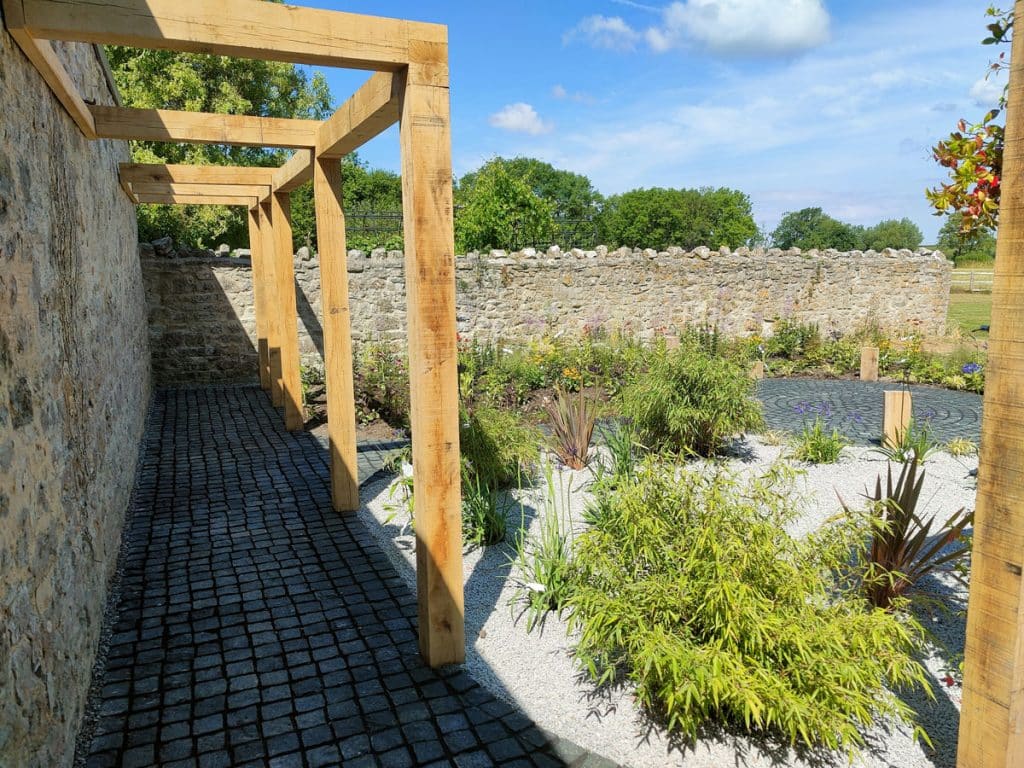
This garden by SilverBirch gardens has plenty of planting, neutral coloured paths and making the most of natural shade.
Read more about this garden in our case study.
North, South, East Or West – Which Way Should Your Patio Point?
You will doubtless have noticed that the sun moves around your garden during the day. The hot spots in the morning will be in different places to the afternoon sun traps. Whilst you can’t control the sun, you can design your garden so that you can either make the most of the sunlight, or escape from it.
Many of the gardens designed and built by SilverBirch gardens have more than one seating area, some also have built in shelters where you can escape the heat of the day (or avoid the wind chill factor in winter).
Before you settle on a garden design, be sure to watch the sun. Are the planned features positioned so that you can enjoy warm weather without getting scorched? Are there shaded spots? If not, is there at least the potential to put up a nice big parasol?
Using Water Features To Make Your Garden Feel Cooler

This pretty garden pool has a gentle fountain and a small deck – the perfect place to sit whilst cooling your toes in the water
Water features are a great way of keeping your garden cool in a heatwave. Of course we’d all like an opulent garden with a swimming pool and room for a pony. But not many of us can realise that dream. So how about a hot tub or a plunge pool to cool off in?
If you don’t fancy putting your swimming cossie on and taking to the water, the next best thing is the sound of moving water. I don’t know how or why, but it seems to trick the brain into thinking the temperature is a little more comfortable. Perhaps it’s because tinkling water is a relaxing sound that helps slow your breathing and calm your senses.
A small water feature, carefully chosen and expertly installed is unlikely to pose a risk to children or pets but can still be a lifeline for insects and birds.
One type of water feature I’d like to design into a garden one day, is a dipping pond. A what? I hear you say.
When you visit a stately home or perhaps a walled garden, it’s not unusual to discover a formal looking pond somewhere that you wouldn’t expect – perhaps in the middle of the walled vegetable garden. More often than not, these are dipping ponds. Decorative water features designed to collect and store rainwater. In dry weather, the gardeners can fill their watering cans from the pond and use it to keep fruit and veg growing strongly. Those old garden designers really did have some sensible ideas!
Frequently Asked Questions
What plants are best for cooling a garden?
Taller plants are great at providing shade, whilst ground cover plants are superb at moderating soil temperatures. Your choice of plants will be dictated by many things such as soil type, aspect and personal taste. But in general, when I want to create a cool and calm atmosphere, I opt for a mix of foliage plants with waxy green leaves such as Fatsia japonica or Trachelospermum jasminoides; I may also plant wonderful grasses that waft in the breeze, trees to cast dappled shade, a natural lawn, palms, ferns, heucheras and possibly even a climbing grape vine for that mediterranean feel.
Which type of pavers are best for a hot garden?
In my experience, all pavers get hot in the summer! The trick is to balance the proportions of hard and soft landscaping in order to dissipate some of the heat. Dark coloured pavers have a lower albedo, meaning that they reflect less of the sun’s energy back into the atmosphere. They will warm up quicker and reach higher tempereatures than light coloured pavers (just like the tarmac on roads). However, they slowly release that energy after sundown meaning that your patio will feel less chilly in the evening. Light coloured pavers bounce the sun’s energy around during the day meaning they are not QUITE as hot to walk on – but they may still be uncomfortable for bare feet – or paws!
Various types of paver also behave differently in the heat. Concrete for example will be hotter than natural stone. Remember though that paving slabs are not the only hard landscaping material, timber decking or clay pavers are also fabulous for patios and paths. Ask your garden designer or landscaper for professional opinion before choosing your colour scheme and/or materials.
How do I keep my dog cool in my hot garden?
Dogs and cats are very good at finding the most comfortable places to be on a hot day and sometimes, the garden is cooler for them than the house. Ensure that you have a wide variety of spaces for them to explore – with plenty of shade from trees, shrubs and structures. Keep your garden well watered (provided there are no restrictions on water use) – damp soil is great for cooling the blood.It’s important that they have drinking water available at all times. Supply ‘quiet’ activities such as lick mats or juicy bones to encourage them to lay still rather than charging around. You may even want to invest in a shade tent. Most importantly of all – supervise your pets in the garden and take immediate action if you spot any signs of distress.
Need More Ideas For Keeping Your Garden Cool In A Heatwave?
Prepare for another heatwave next summer by booking a garden design consultation with Dan from SilverBirch Gardens. He will help you to design and build a garden that looks good and feels comfortable all year round.